
START
CONTACT
Presente
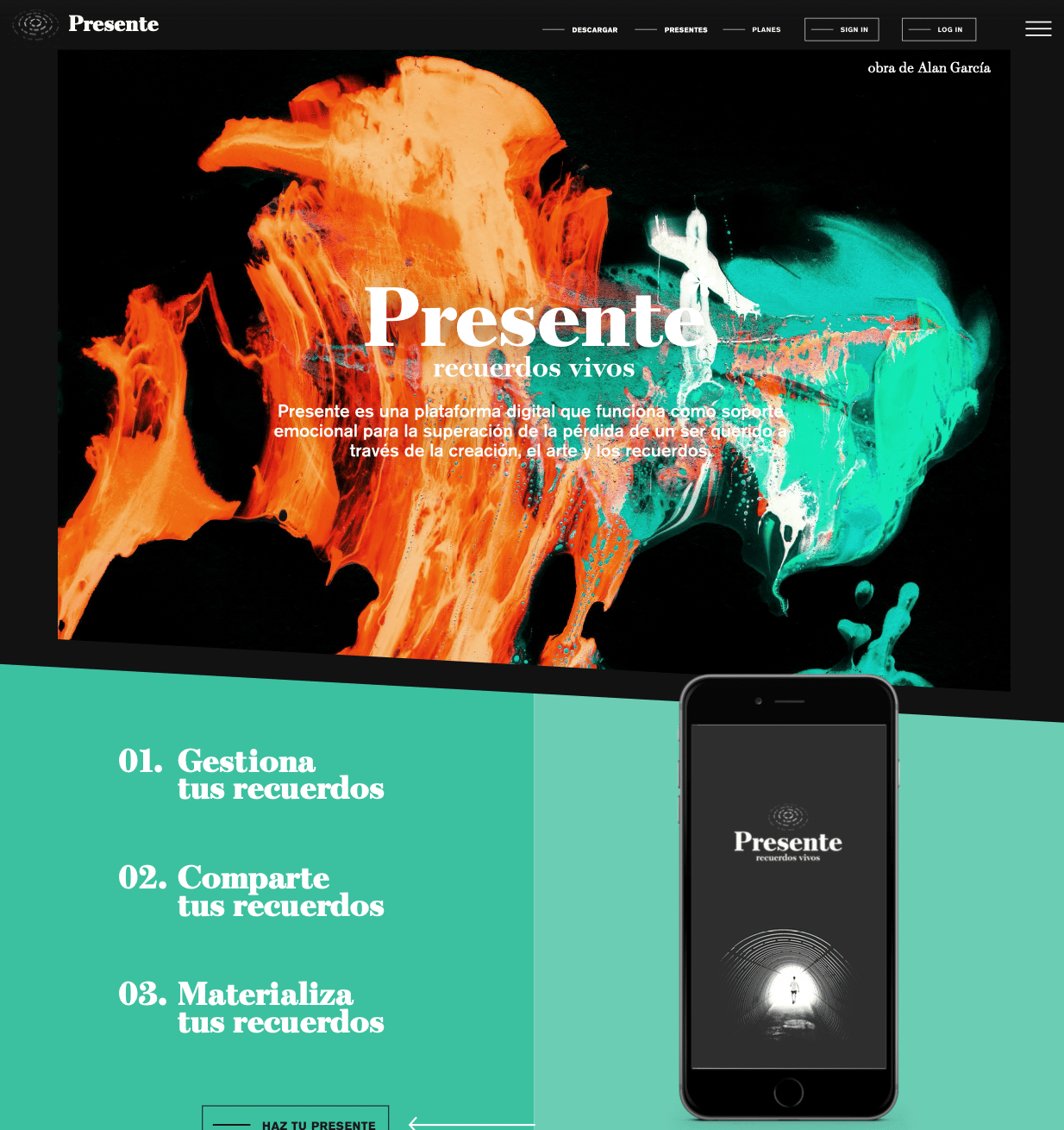
Designing a service that transforms grief into a creative act of memory and healing
Understand the user and their needs, research how the user solves the problem and identifies their shortcomings in order to create a tailored experience
Role:
UX Researcher, UX Designer
Team:
Design Thinking collaborative team
Duration:
8 months
How do you make the loss of a loved one more bearable?
Context
PRODUCT
A B2B platform designed for company managers to upload, store, and manage project information systematically. The platform enables teams to archive all company projects in one place and export that information as downloadable templates for internal and external presentations.
USERS
Company managers who need to organize, retrieve, and share project data efficiently. Users range from those comfortable with complex workflows to those who prefer simplified, guided interactions.
BUSINESS GOAL
Revamp the platform's visual design to align with the company's brand identity, improve usability for day-to-day project management, and create a scalable design system that supports future product growth.
CONSTRAINTS
•
Complex information hierarchies needed to be simplified into intuitive, manageable flows
•
Design had to remain consistent with an existing company style guide while introducing new visual clarity
•
Responsive prototypes required to ensure a seamless experience across devices and screen sizes
•
Tight collaboration needed across stakeholders, designers, and developers to ensure accurate implementation
Research • Concept • Prototyping
Oct 2016 – Jun 2017
Design Thinking
The Challenge

Taboo subject matter: Grief and death are rarely discussed openly in daily life, making it difficult to design a service that feels approachable rather than intrusive or clinical.

Defining the intervention moment: The service had to activate at the right stage of grief, present enough to be useful, but not so immediate as to overwhelm the user.

Emotional complexity of users: Each person experiences grief differently, moving through stages in non-linear, highly personal ways that resist a one-size-fits-all solution.
Tangibility as a core requirement: Research revealed that physical objects carry far greater emotional weight than digital alternatives, making materialization essential, and technically complex, to the service.
The Messy Middle
The Solution
Three Explored Directions: Before arriving at the final solution, the team explored and evaluated three service paths:
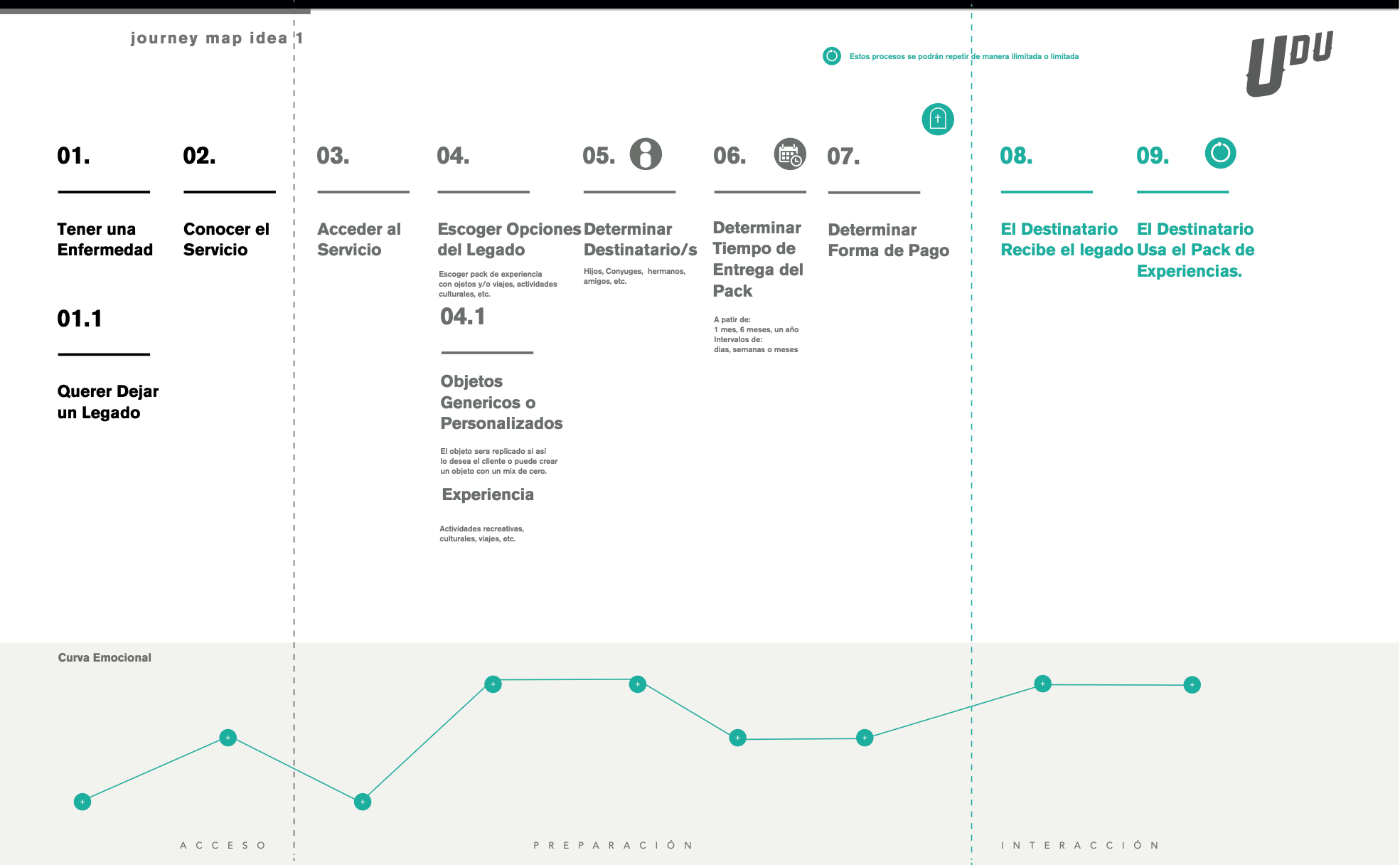
Path 1
Experiences in Life
RATIONALE
A service to foster and document meaningful shared experiences before loss, strengthening bonds while loved ones are still alive. Discarded due to its distance from the grief moment and the absence of physical materialisation.
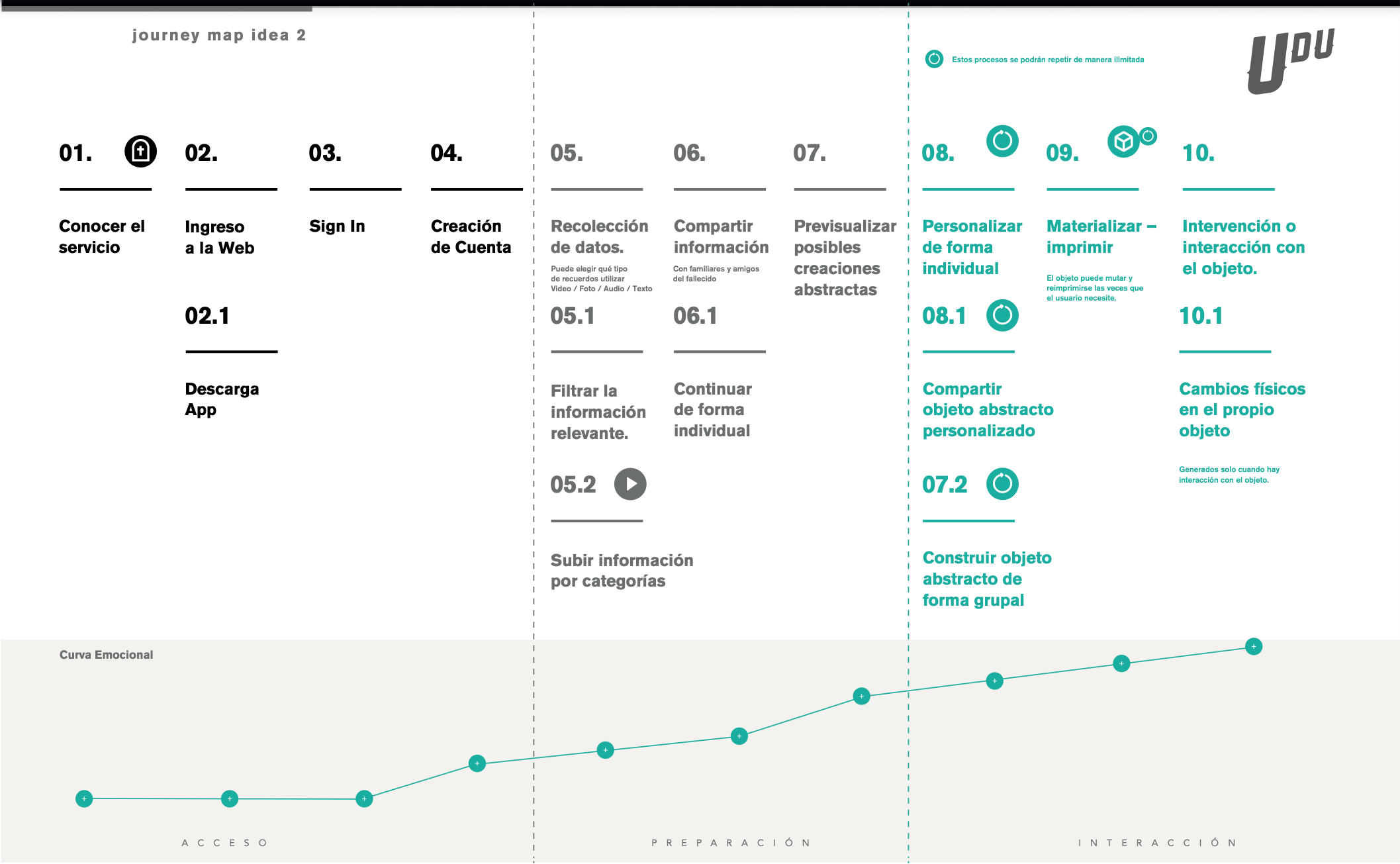
Path 2
Legacies
RATIONALE
A guided service for individuals facing terminal illness to create and leave a legacy for their loved ones. Discarded due to the temporal gap between creation and delivery, and the challenge of targeting the dying person rather than the grieving one.
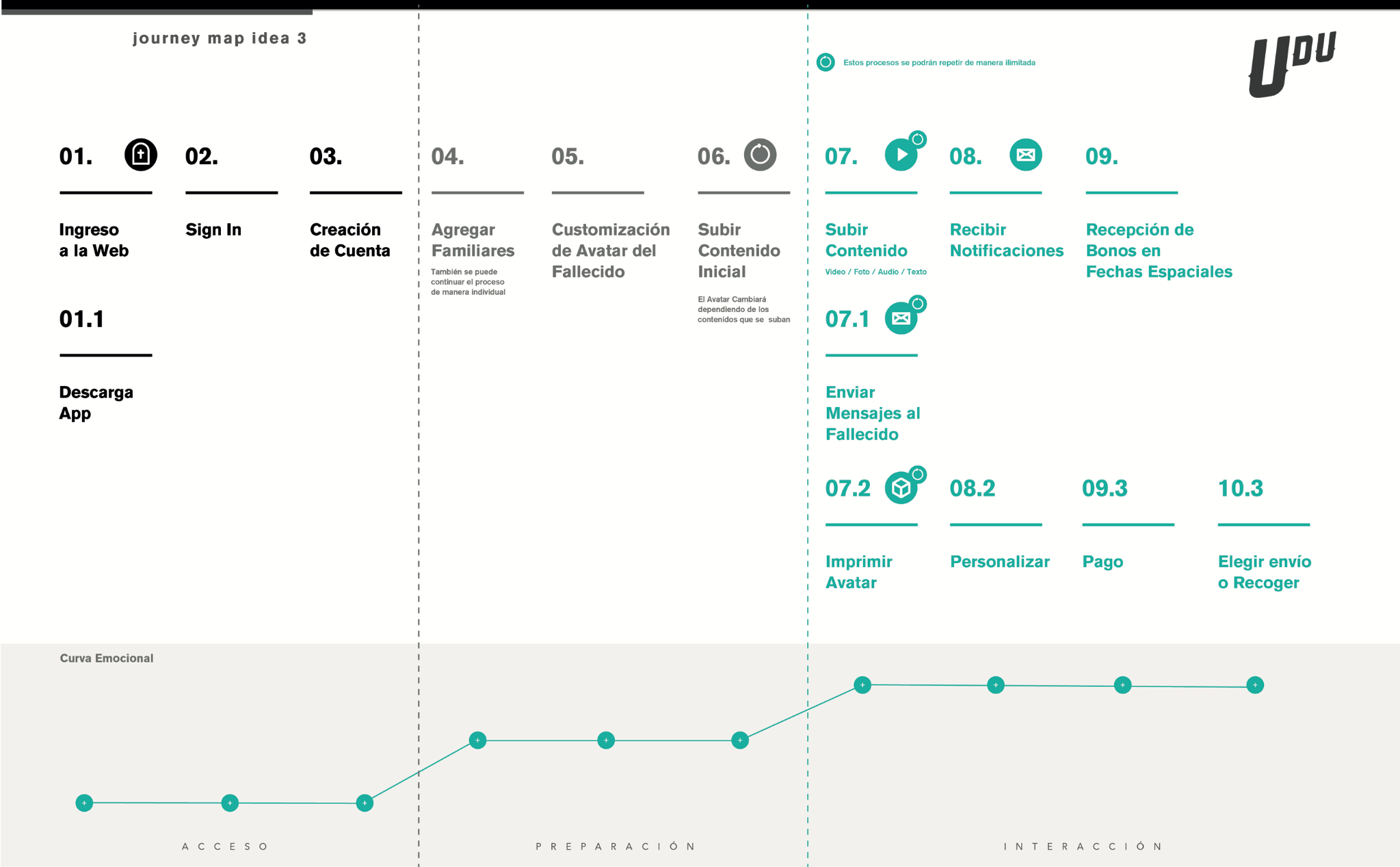
Path 3
Memories (Presente)
RATIONALE
A service where the grieving person, guided by an artist, collects and transforms personal memories into a co-created tangible object. Selected as the strongest path, it targets the right user at the right moment, incorporates creative materialisation, and has a defined and reachable intervention point.
Final Service
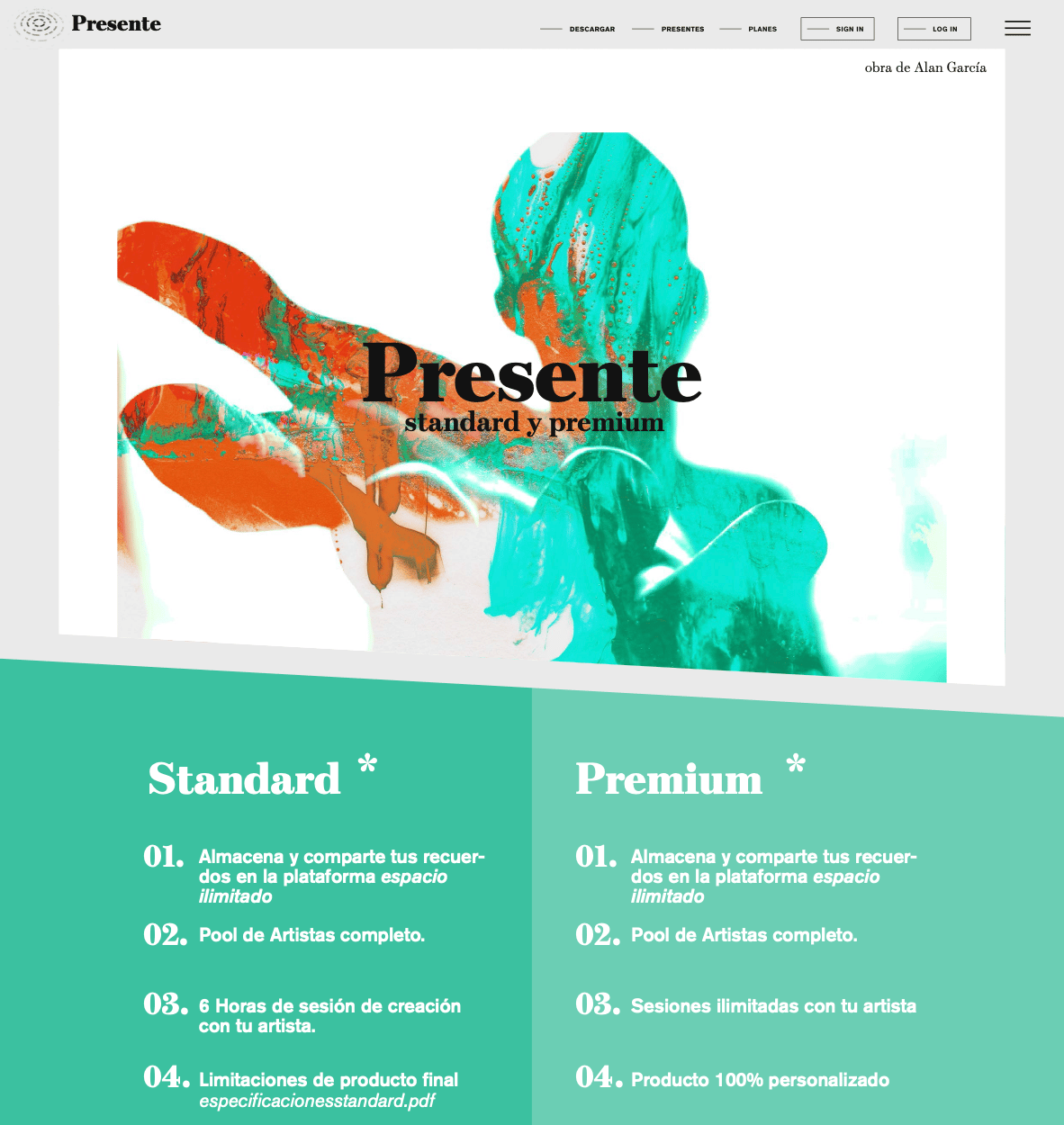
Presente
MEMORY MANAGEMENT
Users upload, store, and manage memories of their lost loved one via text, audio, photo, or video, through guided challenges on the platform.
ARTIST CO-CREATION Users are matched with a trained artist who reviews their memories and collaborates with them to design a personalised object.
MATERIALISATION & DELIVERYThe designed object is produced and delivered to the user, with the option to replicate it for family members.
RATIONALE
Structured prompts help users reconnect with memories in a positive, constructive way, reducing the paralysis that grief can cause.The artist brings creative skill the user may lack, while the guided process provides the therapeutic benefit of active creative engagement.A replicable physical object prevents unhealthy obsession with a single item, while allowing the memory to be shared with the broader family.
Results & Impact

3
Service paths explored and evaluated through a rigorous design thinking process

2
Pototypes tested with real users in grief, generating validated insights about memory, objects, and emotional resonance

8
Insights surfaced from grief research informing every aspect of the final service design

13-Steps
Service blueprint mapped across three stages: Access, Memories, and Creation

1
Full business model developed including Lean Canvas, Business Model Canvas, Value Proposition Canvas, and SAM/SOM/TAM market estimation
100%
Broad scalability identified from Barcelona (SAM) to Spain (SOM) to global market (TAM)
What I Learned

Designing for grief required maintaining a constant balance between empathy and analytical clarity. The prototyping phase was the most emotionally intense part of the process, being close to users' real pain without becoming absorbed in it was a skill developed through the project.
Early research into maker culture and the psychology of grief revealed that the emotional value of a handmade or personally created object far exceeds that of any digital equivalent, this insight became the non-negotiable foundation of the entire service.
Co-creation sessions with users demonstrated that physical objects preferred over digital ones, validating the core hypothesis before any significant design investment was made.
Prototyping in a sensitive context showed that even fictional scenarios, such as imagining one's own death, generate genuine emotional responses that reveal real user needs. This gave us rich, honest data that surveys or questionnaires could never have produced.
The design thinking framework, Discover, Define, Develop, Deliver, proved essential for navigating a topic as complex and emotionally loaded as grief. Without the structured process, it would have been easy to get lost in the vastness and sensitivity of the subject matter.

Design integrated and meaningful experiences.
Let’s Work Together
I’m always interested in hearing about new projects and opportunities.
GET IN TOUCH
© 2026 Johanna Correa. All rights reserved.
Connect


START
CONTACT
Presente
Designing a service that transforms grief into a creative act of memory and healing
Understand the user and their needs, research how the user solves the problem and identifies their shortcomings in order to create a tailored experience
Role:
UX Researcher, UX Designer
Team:
Design Thinking collaborative team
Duration:
8 months
How do you make the loss of a loved one more bearable?
Context
PRODUCT
Presente is a grief support service that guides individuals through the process of loss by helping them materialize their memories of a deceased loved one into a tangible, co-created object. Working alongside an artist, the user transforms personal memories, experiences, and emotions into a physical keepsake a present that helps them honor and preserve the connection with the person they have lost.
USERS
People going through grief following the loss of a loved one, who are open to seeking alternative support to traditional therapy. Users range from those who are deeply creative to those simply looking for a meaningful and personal way to process their loss. Early adopters are people who understand the emotional value of art and are seeking a non-clinical path through grief.
BUSINESS GOAL
Apply the benefits of creativity, technology and object creation to provide emotional support during the grieving process. The service aims to break the social taboo surrounding death and offer a scalable, compassionate alternative to traditional grief therapy, starting in Barcelona and growing toward a national and global audience.
CONSTRAINTS
•
Death is a deeply taboo subject, making it difficult to reach users and introduce the service at the right moment
•
Designing for emotional sensitivity required maintaining empathy without losing objectivity throughout the process
•
Balancing individual needs with a scalable service model required careful iteration
•
Recruiting participants for research and prototyping around such a sensitive topic proved logistically challenging
Research • Concept • Prototyping
Oct 2016 – Jun 2017
Design Thinking
The Challenge

Taboo subject matter: Grief and death are rarely discussed openly in daily life, making it difficult to design a service that feels approachable rather than intrusive or clinical.

Defining the intervention moment: The service had to activate at the right stage of grief, present enough to be useful, but not so immediate as to overwhelm the user.

Emotional complexity of users: Each person experiences grief differently, moving through stages in non-linear, highly personal ways that resist a one-size-fits-all solution.
Tangibility as a core requirement: Research revealed that physical objects carry far greater emotional weight than digital alternatives, making materialization essential, and technically complex, to the service.
The Messy Middle
The Solution
Three Explored Directions: Before arriving at the final solution, the team explored and evaluated three service paths:
Path 1
Experiences in Life
RATIONALE
A service to foster and document meaningful shared experiences before loss, strengthening bonds while loved ones are still alive. Discarded due to its distance from the grief moment and the absence of physical materialisation.
Path 2
Legacies
RATIONALE
A guided service for individuals facing terminal illness to create and leave a legacy for their loved ones. Discarded due to the temporal gap between creation and delivery, and the challenge of targeting the dying person rather than the grieving one.
Path 3
Memories (Presente)
RATIONALE
A service where the grieving person, guided by an artist, collects and transforms personal memories into a co-created tangible object. Selected as the strongest path, it targets the right user at the right moment, incorporates creative materialisation, and has a defined and reachable intervention point.
Final Service
Presente
MEMORY MANAGEMENT
Users upload, store, and manage memories of their lost loved one via text, audio, photo, or video, through guided challenges on the platform.
ARTIST CO-CREATION Users are matched with a trained artist who reviews their memories and collaborates with them to design a personalised object.
MATERIALISATION & DELIVERYThe designed object is produced and delivered to the user, with the option to replicate it for family members.
RATIONALE
Structured prompts help users reconnect with memories in a positive, constructive way, reducing the paralysis that grief can cause.The artist brings creative skill the user may lack, while the guided process provides the therapeutic benefit of active creative engagement.A replicable physical object prevents unhealthy obsession with a single item, while allowing the memory to be shared with the broader family.
Results & Impact

3
Service paths explored and evaluated through a rigorous design thinking process

2
Pototypes tested with real users in grief, generating validated insights about memory, objects, and emotional resonance

8
Insights surfaced from grief research informing every aspect of the final service design

13-Steps
Service blueprint mapped across three stages: Access, Memories, and Creation
1
Full business model developed including Lean Canvas, Business Model Canvas, Value Proposition Canvas, and SAM/SOM/TAM market estimation
100%
Broad scalability identified from Barcelona (SAM) to Spain (SOM) to global market (TAM)
What I Learned

Designing for grief required maintaining a constant balance between empathy and analytical clarity. The prototyping phase was the most emotionally intense part of the process, being close to users' real pain without becoming absorbed in it was a skill developed through the project.
Early research into maker culture and the psychology of grief revealed that the emotional value of a handmade or personally created object far exceeds that of any digital equivalent, this insight became the non-negotiable foundation of the entire service.
Co-creation sessions with users demonstrated that physical objects preferred over digital ones, validating the core hypothesis before any significant design investment was made.
Prototyping in a sensitive context showed that even fictional scenarios, such as imagining one's own death, generate genuine emotional responses that reveal real user needs. This gave us rich, honest data that surveys or questionnaires could never have produced.
The design thinking framework, Discover, Define, Develop, Deliver, proved essential for navigating a topic as complex and emotionally loaded as grief. Without the structured process, it would have been easy to get lost in the vastness and sensitivity of the subject matter.

Design integrated and meaningful experiences.
Let’s Work Together
I’m always interested in hearing about new projects and opportunities.
GET IN TOUCH
© 2026 Johanna Correa. All rights reserved.
Connect
START
CONTACT
Presente
Designing a service that transforms grief into a creative act of memory and healing
Understand the user and their needs, research how the user solves the problem and identifies their shortcomings in order to create a tailored experience
Role:
UX Researcher, UX Designer
Team:
Design Thinking collaborative team
Duration:
8 months
How do you make the loss of a loved one more bearable?
Context
PRODUCT
Presente is a grief support service that guides individuals through the process of loss by helping them materialize their memories of a deceased loved one into a tangible, co-created object. Working alongside an artist, the user transforms personal memories, experiences, and emotions into a physical keepsake a present that helps them honor and preserve the connection with the person they have lost.
USERS
People going through grief following the loss of a loved one, who are open to seeking alternative support to traditional therapy. Users range from those who are deeply creative to those simply looking for a meaningful and personal way to process their loss. Early adopters are people who understand the emotional value of art and are seeking a non-clinical path through grief.
BUSINESS GOAL
Apply the benefits of creativity, technology and object creation to provide emotional support during the grieving process. The service aims to break the social taboo surrounding death and offer a scalable, compassionate alternative to traditional grief therapy, starting in Barcelona and growing toward a national and global audience.
CONSTRAINTS
•
Death is a deeply taboo subject, making it difficult to reach users and introduce the service at the right moment
•
Designing for emotional sensitivity required maintaining empathy without losing objectivity throughout the process
•
Balancing individual needs with a scalable service model required careful iteration
•
Recruiting participants for research and prototyping around such a sensitive topic proved logistically challenging
Research • Concept • Prototyping
Oct 2016 – Jun 2017
Design Thinking
The Challenge

Taboo subject matter: Grief and death are rarely discussed openly in daily life, making it difficult to design a service that feels approachable rather than intrusive or clinical.

Defining the intervention moment: The service had to activate at the right stage of grief, present enough to be useful, but not so immediate as to overwhelm the user.
Emotional complexity of users: Each person experiences grief differently, moving through stages in non-linear, highly personal ways that resist a one-size-fits-all solution.
Tangibility as a core requirement: Research revealed that physical objects carry far greater emotional weight than digital alternatives, making materialization essential, and technically complex, to the service.
The Messy Middle
The Solution
Three Explored Directions: Before arriving at the final solution, the team explored and evaluated three service paths:
Path 1
Experiences in Life
RATIONALE
A service to foster and document meaningful shared experiences before loss, strengthening bonds while loved ones are still alive. Discarded due to its distance from the grief moment and the absence of physical materialisation.
Path 2
Legacies
RATIONALE
A guided service for individuals facing terminal illness to create and leave a legacy for their loved ones. Discarded due to the temporal gap between creation and delivery, and the challenge of targeting the dying person rather than the grieving one.
Path 3
Memories (Presente)
RATIONALE
A service where the grieving person, guided by an artist, collects and transforms personal memories into a co-created tangible object. Selected as the strongest path, it targets the right user at the right moment, incorporates creative materialisation, and has a defined and reachable intervention point.
Final Service
Presente
MEMORY MANAGEMENT
Users upload, store, and manage memories of their lost loved one via text, audio, photo, or video, through guided challenges on the platform.
ARTIST CO-CREATION Users are matched with a trained artist who reviews their memories and collaborates with them to design a personalised object.
MATERIALISATION & DELIVERYThe designed object is produced and delivered to the user, with the option to replicate it for family members.
RATIONALE
Structured prompts help users reconnect with memories in a positive, constructive way, reducing the paralysis that grief can cause.The artist brings creative skill the user may lack, while the guided process provides the therapeutic benefit of active creative engagement.A replicable physical object prevents unhealthy obsession with a single item, while allowing the memory to be shared with the broader family.
Results & Impact

3
Service paths explored and evaluated through a rigorous design thinking process

2
Pototypes tested with real users in grief, generating validated insights about memory, objects, and emotional resonance

8
Insights surfaced from grief research informing every aspect of the final service design

13-Steps
Service blueprint mapped across three stages: Access, Memories, and Creation
1
Full business model developed including Lean Canvas, Business Model Canvas, Value Proposition Canvas, and SAM/SOM/TAM market estimation
100%
Broad scalability identified from Barcelona (SAM) to Spain (SOM) to global market (TAM)
What I Learned
Designing for grief required maintaining a constant balance between empathy and analytical clarity. The prototyping phase was the most emotionally intense part of the process, being close to users' real pain without becoming absorbed in it was a skill developed through the project.
Early research into maker culture and the psychology of grief revealed that the emotional value of a handmade or personally created object far exceeds that of any digital equivalent, this insight became the non-negotiable foundation of the entire service.
Co-creation sessions with users demonstrated that physical objects preferred over digital ones, validating the core hypothesis before any significant design investment was made.
Prototyping in a sensitive context showed that even fictional scenarios, such as imagining one's own death, generate genuine emotional responses that reveal real user needs. This gave us rich, honest data that surveys or questionnaires could never have produced.
The design thinking framework, Discover, Define, Develop, Deliver, proved essential for navigating a topic as complex and emotionally loaded as grief. Without the structured process, it would have been easy to get lost in the vastness and sensitivity of the subject matter.

Design integrated and meaningful experiences.
Let’s Work Together
I’m always interested in hearing about new projects and opportunities.
© 2026 Johanna Correa. All rights reserved.
Connect